

On 1 July 2026, the transitional period for the EU’s Markets in Crypto-Assets regulation (MiCA) ends. After that date, any company providing crypto-asset services in or into the EU without proper authorization is in breach of EU law.
For crypto-native firms, this has been headline news for months. But there’s a quieter story that matters just as much: what it means for ordinary businesses that use crypto as part of normal operations, whether that’s receiving USDC from clients, holding digital assets, or moving value across borders.
If your company touches crypto in any way, or plans to, this guide explains what changes after the deadline, why the assets you hold and the provider you use both matter, and why a regulated account is no longer optional.
What MiCA Actually Covers
A common misunderstanding is that MiCA is only about stablecoins. It isn’t. MiCA regulates the full crypto landscape across all 27 EU member states, and it works on two levels.
The assets. MiCA sorts crypto-assets into categories. Stablecoins backed by a single currency are “e-money tokens” (EMTs). Tokens backed by a basket of assets are “asset-referenced tokens” (ARTs). Everything else, including Bitcoin, Ethereum, and most other tokens, falls into a general crypto-asset category. Each category carries different rules.
The services. Separately, MiCA regulates anyone who provides crypto services: exchanges, custodians, transfer services, order execution, and crypto-to-fiat conversion. These businesses are called Crypto-Asset Service Providers (CASPs), and they need authorization to operate in the EU, no matter which crypto they handle.
This second level is the one most businesses overlook. Even for an asset like Bitcoin, which has no issuer to regulate, the act of exchanging it, holding it for you, or converting it to euros is a regulated service. The provider doing that for you must be authorized.
The Deadline That Changes Things: 1 July 2026
MiCA rolled out in phases. Stablecoin rules took effect in mid-2024. The framework for service providers followed at the end of 2024. Regulators gave existing businesses a transitional window, set by each member state, to come into compliance.
That window closes everywhere on 1 July 2026. ESMA, the EU’s markets regulator, confirmed there will be no extension.
After the deadline, providers serving EU clients without authorization have to stop. Some national regulators have signaled that operating without authorization could carry serious legal consequences. For a business that relies on such a provider, the risk is concrete: if your crypto provider loses EU access, your ability to receive, convert, or withdraw stops with it.
Why Both the Asset and the Provider Matter
After 1 July 2026, two questions determine whether your crypto activity is on solid ground.
1. Is the asset compliant?
For stablecoins, the gap is stark. Among the largest stablecoins by market value, Circle’s USDC and EURC hold full MiCA authorization under the e-money token framework. EU-regulated platforms have excluded USDT from their markets. Major exchanges removed USDT listings for European users ahead of the deadline, because EU-licensed platforms that keep offering non-authorized stablecoins risk their own license.
For other crypto-assets like Bitcoin and Ethereum, the question is less about the asset itself and more about whether the service around it is authorized, which leads to the second point.
2. Is the provider authorized?
This is where most businesses are exposed. Only a fraction of the crypto providers that operated under old national rules have converted to full MiCA authorization. If the exchange or platform you use to convert crypto to fiat isn’t authorized, it has to stop serving EU clients after the deadline, and you lose your off-ramp overnight.
A business using a compliant asset through an unauthorized provider is still exposed. Both layers have to line up.
This is why PaySaxas builds on USDC (ERC20) today, the stablecoin that fits the regulatory direction Europe has committed to, while expanding to support additional crypto-assets like Bitcoin and others within the same regulated framework. The point isn’t which coin you can touch. It’s that whatever you touch, you do it through a regulated account rather than a grey-zone provider.
Why a Regulated Account Beats a Patchwork Setup
For years, the common way to handle crypto in a business looked like this: a self-custody wallet for receiving assets, an offshore or lightly regulated exchange for converting to fiat, and a separate bank account for the resulting euros or dollars. It worked, more or less, because the rules were unclear and enforcement was light.
MiCA ends that era. When the rules are clear and enforced, a patchwork becomes a liability rather than a convenience. Three things change.
Your provider’s regulatory status becomes your problem. If the exchange you convert through loses EU access, your off-ramp disappears. A regulated account operating under European authorization isn’t exposed to the same cliff.
Compliance scrutiny rises, and fragmentation looks like risk. When crypto and fiat sit on different platforms with different standards, documenting the source and destination of funds gets harder, exactly as regulators start paying closer attention. A single regulated account, where crypto converts to EUR or USD internally, keeps everything under one compliance record.
“Grey zone” stops being a strategy. Operating in regulatory ambiguity was tenable when the framework didn’t exist. After 1 July 2026, ambiguity is just non-compliance with extra steps.
A regulated account doesn’t make crypto more complicated. It makes it legible. Your crypto activity happens inside a KYB-verified account, alongside your SEPA and International payments, with one compliance relationship covering all of it.
Looking for a regulated account that handles crypto, EUR, and USD compliantly in one place?
See how PaySaxas works for international companies →
What This Looks Like in Practice
Consider a typical post-MiCA setup for an international business that uses crypto:
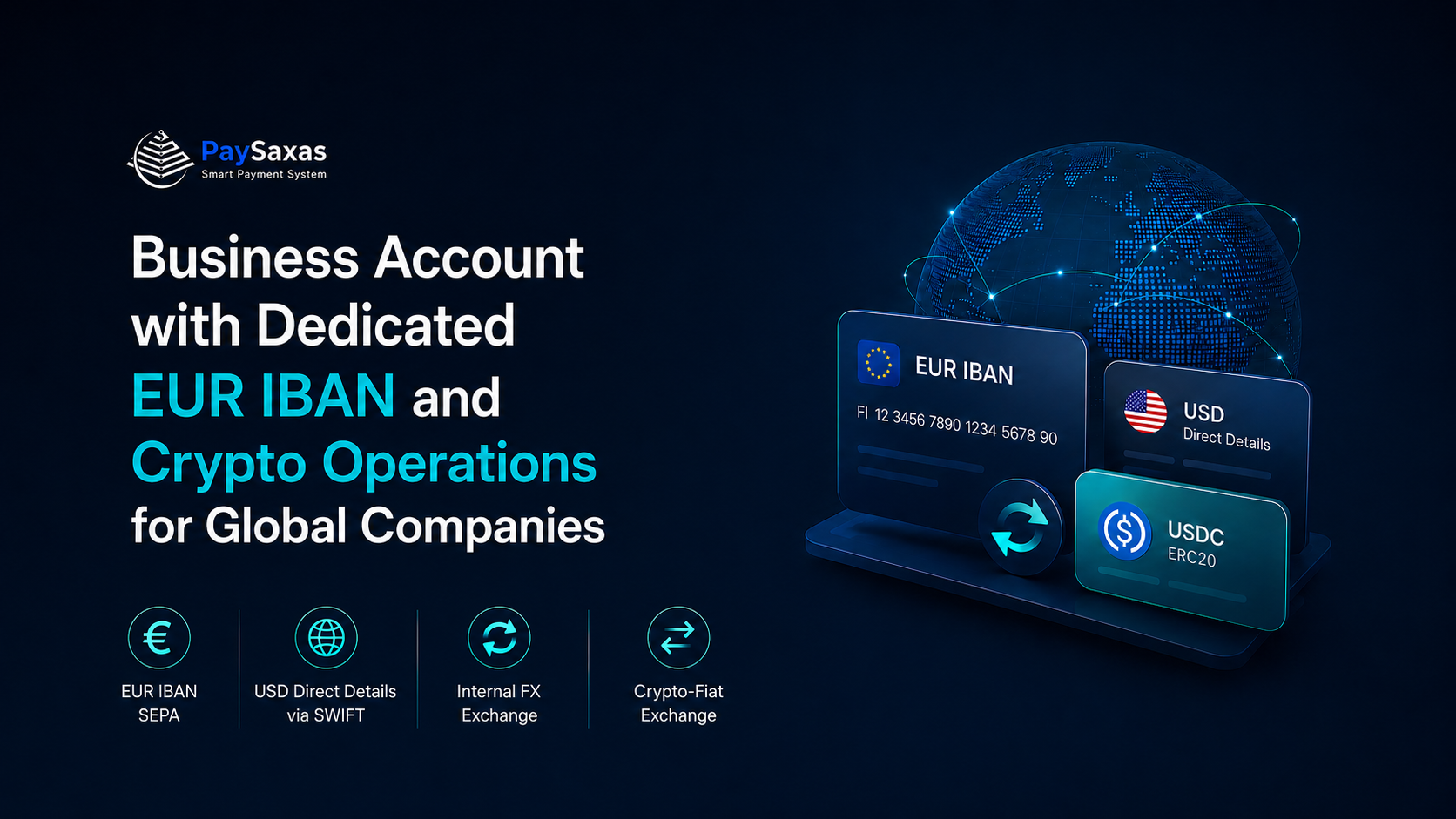
A client pays in USDC. It arrives directly in your business account, which operates under European authorization. Inside the account, you convert it to EUR at a rate shown before execution. From your dedicated EUR IBAN, you pay a European supplier via SEPA. The whole flow happens on one platform, under one KYB, with one transaction history an auditor can follow end to end.
As the same account adds support for assets like Bitcoin, the principle holds: receive, convert, and pay out within a regulated environment, rather than stitching together wallets, exchanges, and banks of uncertain standing.
Now compare the alternative after the deadline: receiving crypto to a wallet, trying to convert it on an exchange that may or may not still serve EU clients, withdrawing to a bank that may question the source of funds, and reconstructing a paper trail across three providers if anyone asks.
The first setup is boring, which is exactly the point. Boring is what compliance rewards.
What Businesses Should Do Before and After the Deadline
Check which assets you actually use. If any part of your operation depends on a non-compliant stablecoin, plan to migrate to a compliant one such as USDC. Don’t wait to find out when a provider drops support.
Review your provider’s regulatory standing. Ask directly whether your crypto provider holds the relevant European authorization and intends to operate past 1 July 2026. If the answer is unclear, treat that as a warning.
Consolidate where you can. Running crypto and fiat through one regulated account reduces both operational overhead and compliance exposure. Fewer providers means fewer points of failure.
Keep clean documentation. Treat crypto transactions like any other: counterparty, amount, purpose, reference. On-chain transaction hashes attached to proper invoices are strong evidence of legitimate activity.
None of this requires deep crypto expertise. It requires using compliant assets through a regulated provider and keeping records, the same discipline that applies to any other part of your finances.
A Note on Onboarding
Access to a regulated crypto-enabled business account depends on KYB and compliance review, and compliance teams do not grant approval automatically. PaySaxas works with companies that have a legitimate and transparent flow of funds, including categories that traditional banks often decline. Clear corporate documentation, identifiable ownership, and a coherent description of your payment flows, including how crypto fits in, move the process faster.
Final Thoughts
MiCA isn’t an attack on businesses that use crypto. For legitimate companies, it’s the opposite: it removes the ambiguity that made crypto payments feel risky and replaces it with a clear rule. Use compliant assets, work with regulated providers, keep records.
The businesses that handled crypto through grey-zone setups will feel the deadline as a disruption. The ones using compliant assets through a regulated account will barely notice it, because they were already on the right side of the line.
Whether you use crypto today or plan to as the space matures, the safest path after 1 July 2026 is also the simplest one: compliant assets, a regulated account, and your crypto and fiat under one roof.
Open a multi-currency business account with PaySaxas →